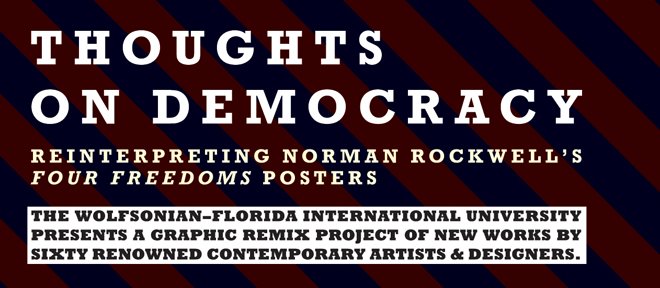
There are 3 Days until Thoughts on Democracy opens at The Wolfsonian!
In addition to Thoughts on Democracy, another exhibition will open at The Wolfsonian-FIU on July 5th:
A BITTERSWEET DECADE: THE NEW DEAL IN AMERICA, 1933–43
On view beginning July 5, 2008 through January 19, 2009, A Bittersweet Decade commemorates the seventy-fifth anniversary of the New Deal, considers the impact of Franklin D. Roosevelt’s programs on American culture and explores how the government’s patronage of art, design, and architecture were integral parts of the larger project of the New Deal, which aimed to spur recovery from the Great Depression and change American society.
Thoughts on Democracy and A Bittersweet Decade kick-off The Wolfsonian's Celebrating America exhibition season. To find out more about the Celebrating America series of exhibits,
THE WOLFSONIAN-FIU ANNOUNCES ITS 2008-2009 ‘CELEBRATING AMERICA’ EXHIBITION SEASON
MIAMI BEACH, FL (April 29, 2008)―The Wolfsonian-Florida International University announces its upcoming exhibition season, “Celebrating America”. Comprised of a series of exhibitions examining the social, political, and cultural American experience from the 1930s to the present, “Celebrating America” showcases four exhibitions: A Bittersweet Decade: The New Deal in America, 1933-43; Thoughts on Democracy; American Streamlined Design: The World of Tomorrow; and The American Automobile Scene.
A Bittersweet Decade: The New Deal in America, 1933-43 (July 5, 2008-January 19, 2009)
Commemorating the 75th anniversary of the New Deal, A Bittersweet Decade: The New Deal in America, 1933-43 considers the impact of Franklin D. Roosevelt’s New Deal programs on American culture. The exhibition, on view July 5, 2008 through January 19, 2009, explores how the government’s patronage of art, design, and architecture were integral parts of the larger project of the New Deal, which aimed to spur recovery from the Great Depression and change American society. Drawing largely on the resources of The Wolfsonian–FIU, and complemented by the collections of local and national supporters, including Martin Z. Margulies, Jason Schoen, Frederic A. Sharf, and Wolfsonian founder Mitchell Wolfson, Jr., this exhibition showcases the range of art and design generated by New Deal programs. Paintings, sculpture, prints, posters, mural studies, photographs, books, models, furniture and a variety of other objects will be on view. Special attention is given to the impact of the New Deal on South Florida, through murals for local post offices, the building of county parks, the establishment of the Key West artists’ colony, and the construction of the Overseas Highway, among other projects.
The exhibition is accompanied by the book, The New Deal in South Florida: Design, Policy, and Community Building, 1933-1940. This compilation of essays, published by the University Press of Florida, explores how local organizations with federal assistance re-shaped the South Florida landscape. It is co-edited by FIU faculty members John F. Stack, Jr. and John A. Stuart and includes essays by landscape architect Ted Baker, Wolfsonian chief curator Marianne Lamonaca, and Cornell University professor Mary Woods, as well as by the two editors.
Thoughts on Democracy (July 5, 2008-December 7, 2008)
The Thoughts on Democracy is comprised of posters created by fifty-five leading contemporary artists and designers, invited by The Wolfsonian to create a new graphic design inspired by American illustrator Norman Rockwell’s “Four Freedoms” posters of 1943, copies of which were recently gifted to the museum by Leonard A. Lauder. Some of the participating artists involved in the project are Neville Brody, Seymour Chwast, Wim Crouwel, Elliott Earls, Richard Tuttle, Lawrence Weiner, Paula Scher, Francesco Vezzoli, Chip Kidd, and Italo Lupi, among others. Rockwell’s images, reproduced by the U.S. Office of War Information for mass dissemination, communicated FDR’s vision of “a world founded upon four essential human freedoms,”—Freedom of Speech, Freedom of Worship, Freedom from Want, and Freedom from Fear. The exhibition will be on view and free to the public in the museum’s lobby from July 5, 2008 through December 7, 2008. Thoughts on Democracy will highlight contemporary notions of democracy. The project will culminate with an event celebrating democracy during the prestigious 2008 Art Basel Miami Beach festival.
American Streamlined Design: The World of Tomorrow (October 23, 2008-May 17, 2009)
Running concurrently with the other two exhibitions, and on view October 23, 2008 through May 17, 2009, is American Streamlined Design: The World of Tomorrow. This exploration of the streamlined style in America is arranged thematically according to the spheres of life – the office, manual labor, home, and recreation. Although it focuses on the 1930s and ‘40s, the period during which streamlined design developed in the United States, the exhibition also presents streamlining in design today. The exhibition offers a fresh appraisal of its subject, placing the achievements of its best-known exponents – among them Norman Bel Geddes, Henry Dreyfuss, Raymond Loewy, and Walter Dorwin Teague – squarely alongside the contributions of lesser-known but significant designers such as Lurell E. Guild, Clifford Brooks Stevens, Harold Van Doren. The exhibition posits that the streamlining of the 1930s is properly understood as a unique stylistic expression.
The most comprehensive traveling exhibition on the subject to be circulated, it is comprised of more than 150 objects—many never exhibited before—including furniture, ceramics, industrial design, original drawings, and book designs. The exhibition makes a case for the vigor of streamlining in today’s design. Among the contemporary designers represented are Jasper Morrison (Thinking Man’s Chair, 1986); Ross Lovegrove (Go Chair, 1999); and Scott Patt (Air Max Contact sneakers for Nike, 2001).
American Streamlined Design: The World of Tomorrow is accompanied by a fully illustrated catalogue, published by Flammarion, Paris. The catalogue provides a scholarly account of the history of streamlining from the 1930s to the present, chronicles the social and stylistic thoughts of the periods, and provides detailed analyses of all the artifacts featured in the exhibition. Available in English and
French editions, the 280-page book features 400 illustrations with essays by David A. Hanks and Anne Hoy, adjunct associate professor, New York University. It is for sale in The Wolfsonian’s Dynamo Museum Shop.
The American Automobile Scene (April-September 2009)
The year-long celebration concludes with The American Automobile Scene, an engaging exploration of automobile design in America from the 1920s through the 1940s, to be presented from April to September 2009. The exhibition examines the role of the automobile in shaping modern American culture. On view will be skillfully and elegantly rendered artworks for concept and production cars; sculpted car models; drawings for automobile showrooms, filling stations, bridges, and roadways; and illustrations for automobile advertisements. These original artworks, together with advertising brochures, auto industry periodicals, and other printed ephemera, will provide audiences with the opportunity to explore how designers and manufacturers of automobiles influenced consumer perceptions. They will also convey the social, political, and economic context of this volatile time period characterized by the Roaring Twenties and the Great Depression through the Second World War.
Monday, June 30, 2008
The Wolfsonian's Celebrating America exhibition series kicks off July 5th, with Thoughts on Democracy and A Bittersweet Decade


Friday, June 27, 2008
Preparing for the Thoughts on Democracy
There are 6 Days until Thoughts on Democracy opens at The Wolfsonian!
The walls are painted, the layout is set, and the posters are ready...


Thursday, June 26, 2008
Countdown to the Exhibition Opening Begins!
There are 7 Days until Thoughts on Democracy opens at The Wolfsonian!
For a "sneak peek" of the show, check out Tim Hossler's artist's rendering to see how the lobby at The Wolfsonian will be transformed...
Before ToD...
After ToD...
Wednesday, June 25, 2008
Exhibition Opening! - Thoughts on Democracy Members Preview and Reception, July 3rd, 2008

The Thoughts on Democracy exhibition will open to the public on July 5th
Monday, June 23, 2008
Chip Kidd


I really, really struggled with this one. I was torn between pursuing two different concepts‹first, the lack of these freedoms in other countries; second, a caution about the abuse of these freedoms in the US. I ultimately went with the latter. The point is that every day we see how these freedoms can not only be taken for granted, but that they can be twisted to harmful ends by the very people they are meant to serve. Thus Freedom from Want leads to rampant obesity; Freedom of Worship leads to using God to hate; Freedom of Speech leads to destruction of property; and Freedom from Fear leads to the proliferation and deadly use of guns.
Chipp Kidd is a graphic designer and writer based in New York City. His book jacket designs for Alfred A. Knopf, where he has worked since 1986, have helped spawn a revolution in the art of American book packaging... The Cheese Monkeys, Kidd’s first novel, was published in 2001 and was a national bestseller, a well as a New York Times Notable book of the Year. His second novel, The Learners, was published in 2008 to tremendous acclaim. A comprehensive monograph of Kidd’s work, CHIP KIDD: BOOK ONE was published in 2005 with an introduction by John Updike; the 400 page book features over 800 works. He is the recipient of the 2007 National Design Award for Communications. Of his work, Time Out New York write: “The history of book design can be split into two eras: before graphic designer Chip Kidd and after.”
Tuesday, June 17, 2008
Design and Politics: Steven Heller's NY Times Article
As the Rockwell and Thoughts on Democracy posters illustrate, design can influence politics (and politics can influence design). Steven Heller, one of the co-curators of the Thoughts on Democracy exhibit, addresses this relationship in the context of the current presidential campaign in his recent NY Times article, "From Mousepads to Piggybanks".
From Mousepads to Piggy Banks (NY Times; May 4, 2008)
This primary season campaign souvenirs are cropping up like kudzu. Retail stores on each of the candidates’ official Web sites offer copious merchandise from lapel pins and mousepads to hoodies and onesies alongside the requisite buttons and bumper stickers. Given the ease with which a logo or slogan can be stamped on any product, the sheer quantity of retail campaign stuff is possibly greater than at any other time in history, albeit a lot less campy than during other elections.
What a particular campaign chooses to sell may not reveal anything momentous about a candidate who has little to say about the inventory (unless, of course, they have relatives in the novelty or dry goods businesses), but the products do say something about how strategists use consumer culture to propagate the candidates’ images (and get free advertising).
So I asked four design critics to examine the quality of the candidates’ online stores, and to go a little below the surface to extract some deeper meaning from the merchandise being sold.
John McCain comes out ahead in the retail offerings with the broadest inventory (from wall clocks to water bottles), notes Julie Lasky, editor of ID magazine. Hillary Clinton comes in a close second (including coffee mugs and plastic piggy banks) and Barack Obama a more focused third.
But the difference is not just quantity. “McCain is the only candidate to offer leisure-class items like polo shirts (including stylishly hued pink ones for men) and sailing jackets before getting down to the nitty-gritty of hoodies,” Ms. Lasky reports. “Clinton and Obama are all about working-class apparel: T-shirts, hoodies and fleece jackets.”
Karrie Jacobs, a contributing editor to Metropolis, concurs that Senator Obama’s merchandise reflects the grassroots insurgent culture of his campaign. She notes that Senator Clinton’s paraphernalia is “conspicuously ugly,” and questions the taste of whoever is in charge of her campaign’s merchandise.
“Where the real editorial opportunity lies,” adds Allan Chochinov, co-founder of Core77.com, an industrial design website and blog, “is in the accessories section, and though the easy targets are Clinton’s ironic ‘ruler’ ($3.50; volume pricing available) and McCain’s more oblique ‘ice scraper’ ($10.00), it’s Obama’s ‘hope bracelet’ that is sure to move the merchandise — 4 bucks each and available in both black and white.”
In a race where the issue of race and ethnicity has reared its predictable head, it is also interesting to see that Senators McCain and Obama especially reach out to their Irish constituencies and their female supporters. Senator Clinton sells her “Hillary for Women” paraphernalia lumped in with narrowly focused buttons for Asian-American and Pacific Islanders, African-Americans, gays, educators, nurses, Jews and veterans — but no mention of the Irish.
Julie Lasky also observes that Senators Clinton and Obama both freely borrow the “Got Milk?” slogan (Obama: “Got Hope?”; Hillary: “Got Experience?”), which is less indicative of their unoriginality than of the ubiquity of the milk campaign.
Alissa Walker, a design blogger, says John McCain’s merchandise works well because it clearly projects the image of a “super-serious” candidate “in shades of black, navy blue and gold.” She points out that his nautical lapel pins and polo shirts emphasize his military experience.
But Ms. Walker was most impressed by his ownership of the four words: leadership, experience, integrity and honor, which emblazon everything from shirts to signs. “Who wouldn’t be proud to borrow a bit from his legacy and stick this leadership sign on their front lawn? Without wearing the standard McCain shirt, you can wear his values with the message of your choice. I really like this option, and the words that he picked. The only bummer here is the women for McCain stuff — truly stereotypical in a sickening shade of Pepto-Bismol pink.”
Senator Obama’s site is the only one to post a disclaimer that some items are back-ordered; whether true or not, it is a brilliant retail tactic.
“But with all the press Obama’s getting for the design of his campaign,” says Alissa Walker, “I was pretty disappointed by his products. There’s really not much that differentiates Obama’s merchandise from Hillary’s: it’s all the same color of blue.”
However, Senator Obama has a unique multimedia section, including a DVD of his speeches. “The Obama-as-cultural-icon angle is absolutely achieved by selling documentary-style videos of him; he’s crossed the line into entertainment,” says Ms. Walker.
She wonders how effective the merchandise on Clinton’s site is since it is “overwhelmingly girly. All the t-shirts look like they’re designed for women or being worn by women. The lapel pins are really matronly, from the Hillary bling pin to her signature pin by Ann Hand, a jewelry artist.” But Ms. Walker loves the “I’m your girl” button with its casual portrait and Senator Clinton’s handwriting. “They should make this image into posters because it gives her campaign a much-needed boost of that evasive personality.”
Julie Lasky observes that in all this, Senator McCain may lose the vote of bargain seekers: at $25, his T-shirts are $4.92 more expensive than similar versions on the Clinton and Obama Web sites.
Monday, June 16, 2008
Thoughts on Democracy on Flickr
Tag, comment, and share images and posters from Thoughts on Democracy with Flickr!
To contribute your own photos to the Thoughts on Democracy Flickr site, use the tag "Thoughts on Democracy."
Thursday, June 12, 2008

Thoughts on Democracy Press Release
THOUGHTS ON DEMOCRACY EXHIBITION DEBUTS JULY 5, 2008 AT THE WOLFSONIAN–FIU
60 Contemporary Artists and Designers Offer Interpretations of Norman Rockwell’s
Iconic “Four Freedoms” Posters
MIAMI BEACH, FL (May 29, 2008) - The Wolfsonian–Florida International University announces Thoughts on Democracy, an innovative initiative that brings together 60 renowned contemporary artists and designers to present original works inspired by Norman Rockwell’s “Four Freedoms” posters. Thoughts on Democracy is part of CELEBRATING AMERICA, a series of four exhibitions on view in 2008 and 2009, that examine and celebrate the social, political, and personal American experience from the 1930s to the present.
In keeping with its theme, Thoughts on Democracy is free and open to the public in the museum’s lobby beginning July 5 through December 7, 2008. The exhibition will culminate with an event celebrating democracy during the prestigious 2008 Art Basel Miami Beach festival. In conjunction with the show, The Wolfsonian is also producing limited-edition portfolios of the new works (available in September), with all proceeds benefiting the graphic arts acquisitions and curatorial and educational programs. A poster that compiles all four of Rockwell’s “Four Freedoms” images is on view in The Wolfsonian’s permanent collection gallery.
“We invited artists and designers to participate in a ‘graphic remix’ that would reinterpret Rockwell’s posters in today’s visual language,” said Wolfsonian Art Director Tim Hossler, who conceived the project and is co-curating the show with Steven Heller, co-chair of the MFA Design Department at the School of Visual Arts. “We are thrilled with the response and are eager to see how the participants’ exploration of democracy stimulates public conversation on the subject.”
Rockwell’s “Four Freedoms” paintings were first published in the Saturday Evening Post in 1943, and were later issued by the government as posters for a U.S. war bond drive. The paintings illustrated the ideals expressed in Franklin Delano Roosevelt’s impassioned “Four Freedoms” speech to Congress in 1941, in which he envisioned a “world founded upon four essential human freedoms”—Freedom of Speech, Freedom of Worship, Freedom from Want, and Freedom from Fear.
“We are always looking for new, provocative ways to foster dialogue around our collection in relation to contemporary issues, particularly when we are able to involve contemporary artists and graphic designers,” said The Wolfsonian’s director, Cathy Leff. “Thoughts on Democracy will be a fascinating and timely reflection of how Roosevelt’s universal ideals, articulated in 1941, are interpreted and expressed in 2008.” She explained that The Wolfsonian’s impetus for the project was a recent gift of the “Four Freedoms” posters to the museum by Leonard A. Lauder.
The public will also be able to enjoy and contemplate the new works beyond the museum walls. The Wolfsonian, in partnership with the award-winning international advertising agency Crispin Porter + Bogusky, also playing a role as exhibitor, will display the posters in newspapers and on billboards. The Wolfsonian will also offer public educational programming in conjunction with the exhibit and promote dialogue about the show on the internet using web-based tools (Flickr, iGoogle gadgets), a Thoughts on Democracy blog (http://thoughtsondemocracy.blogspot.com), virtual worlds, and social networking sites (The Wolfsonian Facebook page).
In keeping with the spirit of expanding Thoughts on Democracy into the greater public domain, The Wolfsonian will also partner with Turnberry for the Arts to present a concurrent exhibition of the posters in the Aventura Mall (www.aventuramall.com), 19501 Biscayne Boulevard, beginning July 5 through August 2008. “Turnberry for the Arts is delighted to have the opportunity to share the artworks in this exciting and timely exhibition with visitors at Aventura Mall. The Thoughts on Democracy project is a wonderful complement to the works by contemporary artists that are permanently on display at the mall. Two of the artists - Lawrence Weiner, whose installation is currently on view here, and Daniel Arsham, whose installation will be unveiled at the mall this fall, are also featured in The Wolfsonian's exhibition," noted Jacqueline Fletcher, Director of the Turnberry for the Arts program.
All artists and designers included in the exhibition have generously donated their time and creativity. Thoughts on Democracy is supported by a generous grant from the Funding Arts Network (FAN), in partnership with the John S. and James L. Knight Foundation. The Wolfsonian is the only recipient of FAN’s Knight New Work Award for 2008; the $50,000 grant was awarded to the museum in May 2008. “The ambitious scale of Thoughts on Democracy and its resonating message of democracy made this project irresistibly compelling,” said Rachel Blechman, president of FAN. Additional support for Thoughts on Democracy is provided by Turnberry for the Arts exhibited at the Aventura Mall.
About the artists
As illustrated by the quantity and quality of the posters that will be on display, the idea behind Thoughts on Democracy was received with an outpouring of enthusiasm by the participants. Local, national, and international visual artists, graphic designers, and one poet contributed works to the project. A brief biography of select artists from the exhibition, and a statement about their poster follows below:
Elliott Earls is a performance artist, musician, and designer, and is designer-in-residence and head of the Graduate Graphic Design Department at Cranbrook Academy of Art. Earls has lectured extensively at American universities, and has given workshops on design, culture and new media in Europe and America.
Artist’s Statement: Entitled “Liberty Weeps,” Elliott Earls’ contribution to The Wolfsonian’s Thoughts on Democracy poster project was inspired by Eugene Delacroix's "Liberty Leading the People." In this piece, Liberty is embodied in the innocence of a crying child. Is Liberty crying for the victims of September 11th? Is Liberty crying over the loss of civil liberties in the War on Terror? Is Liberty crying for our fallen soldiers in Iraq or for the prisoners at Guantanamo Bay? The open nature of the language in this poster contrasted with the specificity of the image is meant to provoke discussion.
Experimental Jetset is an Amsterdam graphic design unit founded in 1997 by Marieke Stolk, Erwin Brinkers and Danny van den Dungen. Focusing on printed matter and installation work, Experimental Jetset has worked on projects for the Amsterdam Stedelijk Museum (SMCS), Purple Institute, Centre Pompidou, Colette, Dutch Post Group (TPG), Réunion des Musées Nationaux (RMN), Le Cent Quatre (104), De Theatercompagnie, and t-shirt label 2K/Gingham.
Artist’s Statement: The slogan “Loose Lips Build Ships” is a collision of two iconic WWII posters: the “Freedom of Speech” poster as painted by Rockwell, and the “Loose Lips Sink Ships” poster, the US Office of War Information's attempt to limit the possibility of people inadvertently giving useful information to enemy spies.
On the one hand, our contribution is a tribute to the concept of freedom of speech: the idea that all constructive things start with an open exchange of ideas. On the other hand, we wanted to show our uneasiness with the concept of propaganda. Acknowledging freedom of speech by turning a propaganda slogan on its head is our attempt to create a little bit of friction, or better said, to reveal a friction that is already there.
Taku Satoh is a Tokyo-based graphic and product designer, and the director of 21_21 DESIGN SIGHT in Tokyo. He attended Tokyo National University of Fine Arts and Music for both undergraduate and graduate school and then joined the firm Dentsu, before establishing the Taku Satoh Design Office in 1984.
Artist’s Statement:
Inspired by the four posters of freedoms drawn by Normal Rockwell, I have added
the most important kind of freedom for the present time.
That is “Freedom to Imagine.” Nothing should prevent imagination.
Imagination creates the future. Imagination cultivates technology.
Imagination saves the environment. Imagination protects human rights.
Imagination prevents battles. Imagination creates art.
Everything begins with imagination.
Of course it is imagination for coexistence of different cultures, not a selfish imagination.
Scott Stowell is the proprietor of Open, an independent design studio that creates rewarding experiences for people that look, read, and think. Before starting Open, Stowell received a BFA in graphic design from Rhode Island School of Design and served as the art director of Colors magazine in Rome and a senior designer at M&Co. New York. A former vice president of AIGA/NY, Stowell teaches at Yale and the School of Visual Arts.
Artist’s Statement: This poster uses words – from FDR's speech and Rockwell's posters – distilled into calls to action that are still relevant and urgent today. The typography was inspired both by traditional "show print" posters and the I AM A MAN signs from Martin Luther King's 1968 march in Memphis. Two of these calls to action are usually heard from the left. They appear in blue. The other two, more often heard from the right, are in red.
Lawrence Weiner is a central figure in the history of conceptual art, whose work often takes the form of typographic texts. The first presentation of his work was in Mill Valley, California in 1960. He participates in public and private projects and exhibitions in both the new and old world maintaining that: art is the empirical fact of the relationships of objects to objects in relation to human beings and not dependent upon historical precedent for either use or legitimacy.
Artist’s Statement:
LIFE • LIBERTY • & • THE PURSUIT OF HAPPINESS
N'EST-CE-PAS?
About The Wolfsonian–Florida International University
The Wolfsonian is a museum, library, and research center that uses objects to illustrate the persuasive power of art and design, to explore what it means to be modern, and to tell the story of social, historical, and technological changes that have transformed our world. The collections comprise approximately 120,000 objects from the period of 1885 to 1945—the height of the Industrial Revolution to the end of the Second World War—in a variety of media including furniture; industrial-design objects; works in glass, ceramics, and metal; rare books; periodicals; ephemera; works on paper; paintings; textiles; and medals.
The Wolfsonian is located at 1001 Washington Avenue, Miami Beach, Fla. Admission is $7 adults; $5 seniors, students, and children six-12; free for Wolfsonian members, State University System of Florida staff and students with ID, children under six, and Miami Beach residents with ID. The museum is open Monday, Tuesday, Saturday and Sunday from noon-6pm; Thursday and Friday from noon-9pm; and is closed on Wednesday. Contact us at 305.531.1001 or visit us online at www.wolfsonian.org.
The Wolfsonian receives ongoing support from the State of Florida, Department of State, Division of Cultural Affairs; the Florida Arts Council; the National Endowment for the Arts; the Miami-Dade County Department of Cultural Affairs and the Cultural Affairs Council; the Miami-Dade County Mayor and Board of County Commissioners; the City of Miami Beach, Cultural Affairs Program, Cultural Arts Council; the Arthur F. and Alice E. Adams Foundation; the William J. & Tina Rosenberg Foundation; Continental Airlines, the preferred airline of The Wolfsonian; Crispin Porter + Bogusky; The Miami Herald; Bacardi U.S.A., Inc; Robert Mondavi Winery; and Pistils & Petals.


